Official news Romanian football
Universitatea Craiova's Conference League Hopes Analyzed Following Europa League Exit
After dropping to the UEFA Conference League following a play-off defeat, Universitatea Craiova faces a challenging group stage campaign with statistical projections suggesting a difficult path to advancement under manager Filipe Coelho.
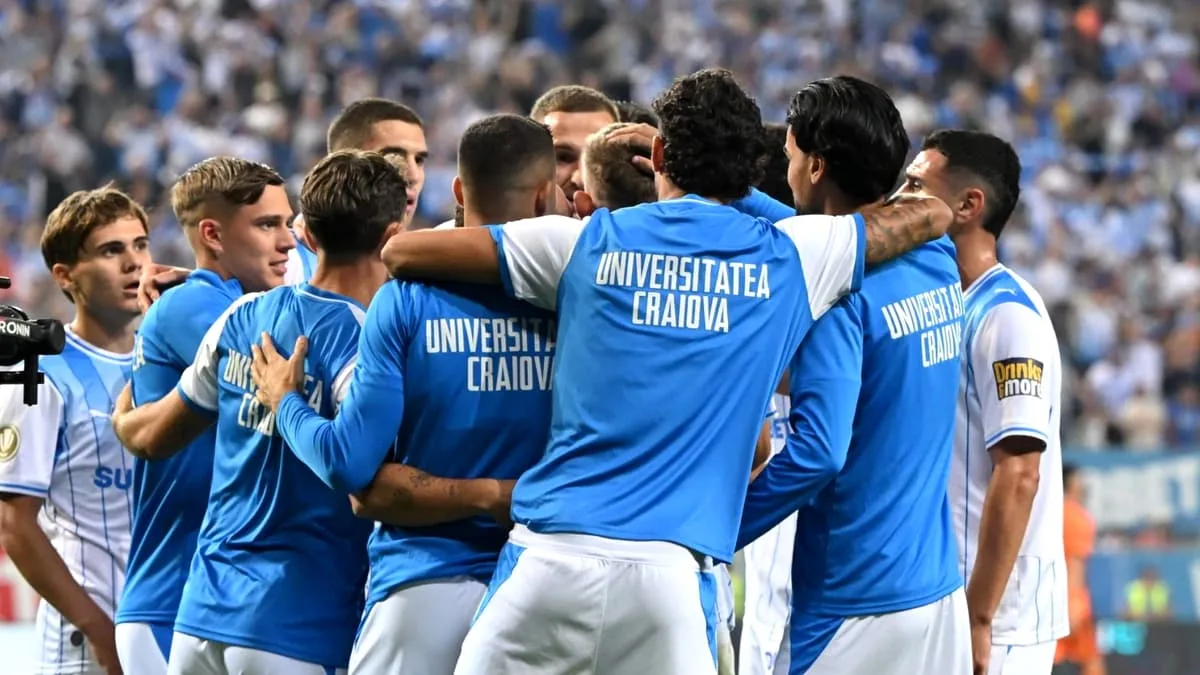
Photo credit
Photograph accompanying the original Fanatik report.
Photo: Fanatik · Universitatea Craiova's Conference League Hopes Analyzed Following Europa League Exit · Cropped for display
Universitatea Craiova’s European campaign has taken a significant turn after their elimination from the Europa League play-offs. The Romanian side suffered a defeat against Ararat-Armenia, a result that has relegated them to the UEFA Conference League group stage for the current season. This transition marks a shift in expectations for the club, which had aimed for the higher-profile competition but now must navigate the third-tier European tournament. The loss to the Armenian outfit effectively ended their hopes of progressing further in the Europa League, forcing a strategic pivot as they prepare for the new competitive landscape.
The outlook for Universitatea Craiova in the Conference League is being closely monitored by data analysts, who have issued somewhat pessimistic forecasts regarding their chances of success. A supercomputer model developed by Football Meets Data projects the team, currently managed by Filipe Coelho, to finish in 21st place within the league phase standings. According to these projections, the club is expected to accumulate only 7.8 points throughout the group stage. These figures suggest that the mathematical likelihood of a strong performance is low, placing the team in a precarious position relative to their opponents in the newly structured format.
The specific challenges facing Universitatea Craiova are highlighted by the identity of their projected opponents in the group stage. The schedule includes matches against a diverse array of teams, ranging from established European clubs to sides from smaller footballing nations. Key fixtures include home and away encounters with Getafe, Brighton, and FC Copenhaga, all of whom represent formidable opposition in terms of squad depth and tactical sophistication. Additionally, the team will face Inter Club d’Escaldes, Egnatia, and Kairat Almaty, creating a balanced but demanding fixture list that tests resilience across different playing styles and environments.
Statistical models provide a nuanced view of the probabilities associated with Universitatea Craiova’s participation in the tournament. While the overall projection is modest, there remains a viable pathway for progress. The data indicates a 65.2% probability that the club will advance to the knockout stage of the competition. However, the chances of achieving a top-eight finish, which would secure automatic qualification for the next round without needing playoffs, are significantly lower at 11.3%. These percentages underscore the difficulty of the task ahead, suggesting that while elimination is not guaranteed, securing a high-ranking position in the group will require exceptional performance.
Contextualizing this season’s prospects requires an examination of Universitatea Craiova’s recent history in European competitions. In the previous season, the club finished 25th in the Conference League group stage, accumulating just 7 points with a goal difference of -2. Their failure to progress was determined by tie-breakers that favored Zrinjski Mostar and Sigma Olomouc, highlighting how narrow margins often dictate outcomes in this tournament. This historical performance serves as a baseline for comparison, indicating that the team has previously struggled to convert potential into tangible results when competing against similar tiers of opposition.
A detailed review of last season’s match results reveals both flashes of brilliance and recurring vulnerabilities for Universitatea Craiova. The team demonstrated their capacity to upset stronger opponents by securing 1-0 victories over Rapid Vienna and Mainz 1-0. These wins showcased their ability to compete on the counter-attack or through defensive solidity. However, these positives were offset by inconsistent performances elsewhere, including a 0-2 loss to Rakow and a 1-1 draw with Noah, which failed to provide the necessary momentum for advancement.
The most telling indicators of struggle came in defeats to more dominant European sides. Universitatea Craiova lost 1-2 to Sparta Prague and suffered a heavy 2-3 defeat against AEK Athens, despite having led 2-0 at one point in the latter match. This collapse against AEK Athens exemplifies the fragility of their lead management and defensive concentration levels during critical moments. Such lapses contributed directly to their poor standing in the previous group stage, where they ultimately missed out on qualification due to superior tie-breaker statistics held by rivals Zrinjski Mostar and Sigma Olomouc.